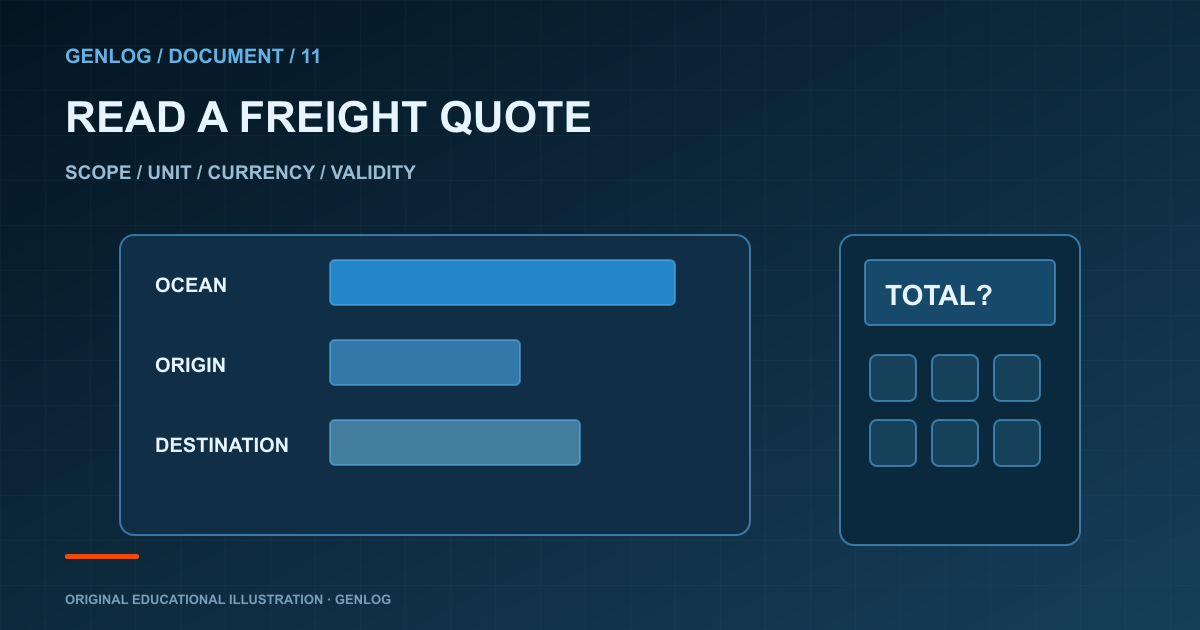
A transport quotation must be read with route, equipment, validity and applicable conditions. “All-in” does not explain its own scope when inclusions and exclusions are unspecified.
Use a common comparison sheet
GENLOG suggests columns for charge, unit, quantity, currency, validity and notes. Separate ocean, origin/destination, inland and optional services. The sales-contract delivery term helps check scope but does not replace a service quotation.
Compare scope before comparing prices
A cheaper quote may cover fewer tasks. Define exact collection and delivery points, the sale’s Incoterm, cargo, equipment, schedule and responsibilities. A freight quote does not itself amend the sales contract.
Field
Review question
Comparable record
Scope
Door or port, from where to where?
Addresses and included stages
Unit
Shipment, container, kg or W/M?
Rate multiplied by chargeable quantity
Currency
Which conversion basis and date?
One stated comparison currency
Inclusion
Local charges, customs, truck, insurance?
Included, excluded or conditional
Validity
Booking date, sailing date or another basis?
Written dates and conditions
Six steps for quotation approval
Send a consistent RFQ with route, cargo characteristics, packages, dimensions, weights, equipment, dates and delivery term.
Request mandatory, optional and unresolved items, including tax, surcharges and validity limitations.
Map all proposals to one scope sheet. Ask about blanks rather than treating them as zero.
Check actual dimensions, chargeable weight and minimums. For W/M obtain the specific quoted rule instead of assuming one ratio for every service.
Approve the final version and retain booking and change confirmations. Reconcile the invoice with the quote and authorised extras after delivery.
Normalise two hypothetical offers
For the same illustrative scope, A has freight 800 USD, origin fees 150 and trucking 200: known total 1,150. B has freight 750, origin fees 180 and trucking 250: known total 1,180. B’s main freight is lower but these combined items cost 30 more.
Neither states destination fees, tax or possible inspection expenses. Do not call 1,150 a final all-inclusive total while items remain unresolved. Clarify the payer and coverage of each item. Show conversion assumptions separately for mixed currencies. These figures teach comparison and are not GENLOG service rates.
Common questions
Is “all-in” sufficient? Obtain inclusions, exclusions and conditions in writing.
Does validity at booking guarantee the rate at sailing? Check the quoted basis and reconfirm after schedule changes.
Is LCL charged only by CBM? Verify minimums and each item’s weight/measurement basis.
Why is the invoice higher? Reconcile actual quantities, route, timing, exchange rates and approved extras; do not assume every difference is valid.
Questions before acceptance
Is the unit a container, TEU, shipment, kilogram or CBM? What dates, exchange basis and taxes apply? Check amendments, cancellation, free time and possible extra charges. Obtain written confirmation rather than combining benefits from unrelated offers.
References
GENLOG practical guide, reviewed on 24 October 2026 using public primary sources. Examples are illustrations, not official tariffs or contract templates.
{"lang":"en","ui":{"home":"Home","services":"Services","lookup":"Lookup","tools":"Tools","knowledge":"Insights","contact":"Contact","quote":"Get a quote","explore":"Explore the platform","search":"Search","ports":"Ports \/ locations","carriers":"Shipping lines","container":"Container","searchPlaceholder":"Search port, location or shipping line…","trackingNote":"Track shipments on the shipping line’s official website.","map":"Logistics map","mapNote":"Geographic reference map; does not provide live vessel or shipment positions.","expand":"Expand map","cbm":"CBM calculator","cbmDesc":"Calculate shipment volume from package dimensions and quantity.","units":"Unit converter","unitsDesc":"Convert length, mass and volume.","containerDesc":"Validate ISO 6346 format and check digit.","carriersDesc":"Find shipping line websites and information from verified sources.","name":"Full name","company":"Company","email":"Email","phone":"Phone","service":"Service","origin":"Origin","destination":"Destination","cargo":"Cargo description","weight":"Total weight (kg)","volume":"Total volume (m³)","date":"Expected shipping date","notes":"Notes","consent":"I agree that GENLOG may use this information to respond under its","privacy":"Privacy policy","submit":"Send enquiry","formNote":"Fields marked * are required. Do not submit passwords or payment details.","sea":"Ocean freight","air":"Air freight","road":"Domestic transport","warehouse":"Warehousing","customs":"Customs clearance","transit":"Laos \/ Cambodia transit","other":"Other service","quoteReceived":"Your enquiry has been saved and accepted by the email system. GENLOG will contact you.","quoteSaved":"Your enquiry was saved. Email delivery is temporarily unavailable; contact alex@genlog.vn.","formError":"Some information is invalid. Please review the form.","requiredError":"Please complete all required fields.","rateError":"Too many enquiries. Please try again later.","notFound":"Page not found","backHome":"Return to home","close":"Close","length":"Length (cm)","width":"Width (cm)","height":"Height (cm)","quantity":"Packages","calculate":"Calculate","result":"Result","validContainer":"The container check digit is valid.","invalidContainer":"The check digit does not match.","formatContainer":"Enter 3 owner letters, U\/J\/Z, and 7 digits.","checkNote":"This checks only the format and check digit. It does not confirm existence or live location.","noResults":"No matching results yet. Contact GENLOG for assistance.","loading":"Searching…","networkError":"Connection unavailable. Please try again.","unitFrom":"From unit","unitTo":"To unit","value":"Value","directoryNote":"Directory entries are maintained from official sources. No live tracking data is provided.","readMore":"Read more","sources":"Data sources","terms":"Terms","footerTitle":"Connect with GENLOG","menu":"Open menu","cbmNote":"CBM is geometric volume. Chargeable weight and freight rates depend on the service and carrier.","platform":"LOGISTICS PLATFORM","countryFilter":"Country \/ territory","allCountries":"All countries","showMore":"Load more results","resultsCount":"{total} results found","catalogNote":"UN\/LOCODE {version} · {ports} port-function locations · {countries} countries\/territories.","menuClose":"Close menu","intro_services":"Transport solutions for each shipment, connecting Vietnam with international markets.","intro_lookup":"Find ports worldwide by name, UN\/LOCODE or country, with clear data sources.","intro_tools":"Calculate CBM, convert units and validate container numbers in one clear workspace.","intro_knowledge":"Practical information to help businesses prepare shipments and understand logistics.","intro_contact":"Share your shipment details. GENLOG will advise on a suitable solution and quotation.","intro_privacy":"How GENLOG receives and protects the information you provide.","intro_terms":"Guidelines for using the GENLOG platform, tools and logistics information.","intro_sources":"Data sources, versions and reference scope for the platform’s tools.","officialWebsite":"Official website ↗","cityFilter":"Head-office city","allCities":"All cities","carrierCountryFilter":"Head-office country \/ territory","carrierLocationNote":"Includes container, regional and other maritime freight operators. Filters use head-office locations, not route coverage or all local offices.","carrierSearchPlaceholder":"Carrier name, code or city…","documentMenu":"Open Document groups","selectSearch":"Type to find an option…","selectEmpty":"No matching options","selectOpen":"Open options","documentOverview":"Document overview","guideContents":"In this guide","quoteQueued":"Your enquiry has been saved. The email notification is queued, but mailbox delivery is not yet confirmed.","carrierCatalogNote":"Directory of {carriers} operators across {countries} countries\/territories."},"csrf":"846b02fb8152fe39483538a4f085778d00df83718f7fd88ce7395f7d3ad68bd3"}