No single document set fits every product and destination. Confirm product, market and receiver requirements before finalizing documents, transport and milestones.
Step 1: agree the input data
Record product characteristics, packing, quantity, weight, dimensions, origin and final delivery point. Agree the delivery term, readiness date and desired timing. Ask the receiver about import requirements instead of applying an unverified generic template.
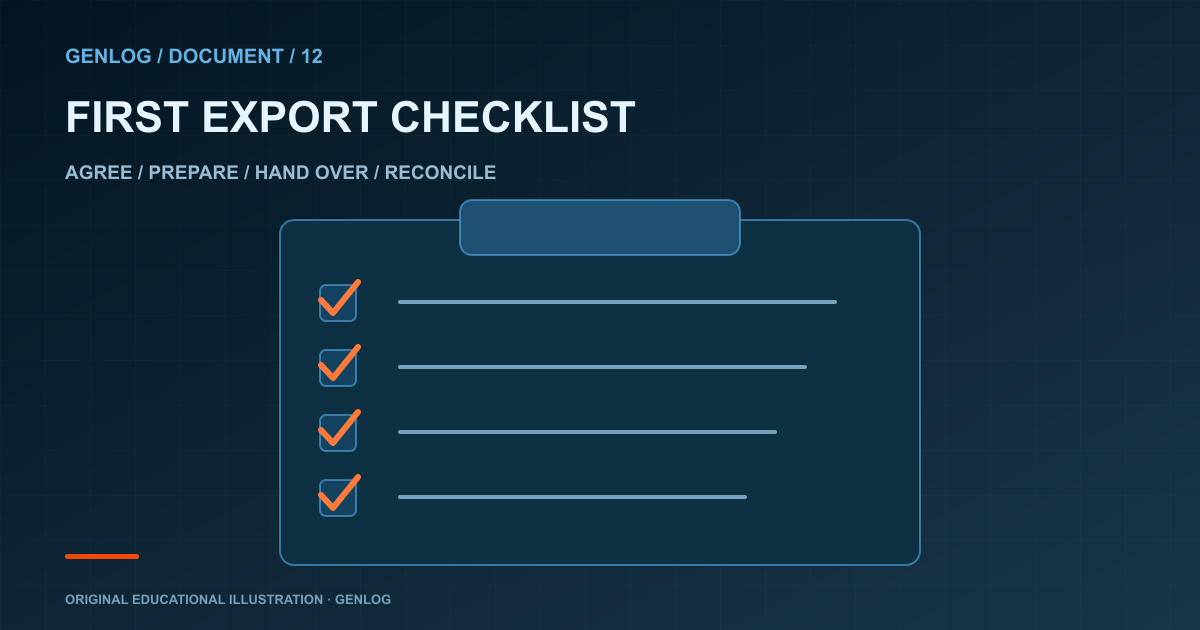
Give every stage an owner and evidence
A useful first-shipment checklist names the responsible person, deadline and completion record. Required permits and certificates vary by product, destination and agreement; establish them before committing to a transport schedule.
Stage
Coordinators
Retained output
Sale
Sales, buyer and finance
Contract, delivery and payment terms
Product requirements
Production, compliance and declarant
Specifications and applicable permit requirements
Transport booking
Logistics and provider
Booking, quote scope and cut-offs
Packing and handover
Warehouse, truck, customs and documents
Packing, SI, applicable VGM and handover records
Completion
Logistics, buyer and accounts
Receipt status, invoices and reconciliation
Ten steps from order to reconciliation
Confirm applicable trade and transport requirements; disclose batteries, chemicals and other special characteristics before booking acceptance.
State the Incoterm with place and edition, and separately agree payment, quality, insurance and change handling.
Prepare product data and consult the declarant about classification, origin and necessary permits or certificates. A generic checklist cannot decide a product-specific requirement.
Compare equivalent quotes, confirm equipment, locations and schedule, and check SI, VGM, CY and applicable customs milestones.
Pack and mark for the journey, prepare the actual packing list and retain photographs and handover records.
Prepare invoice, SI and other documents with assigned approval. For ocean containers arrange VGM through an accepted method and process.
Coordinate declarations and delivery before deadlines; track accepted status rather than only dispatch or submission.
Review draft documents, approve final issue and perform the agreed document-delivery or release process alongside payment requirements.
Track sailing changes, inform the buyer and prepare receipt and equipment return within the actual agreed free time where responsible.
Reconcile invoices and authorised extras, complete the file and record improvements for the next shipment.
A planning and contingency example
Assume packing on Monday and cut-offs on Tuesday. Confirm product acceptance, packaging, booking and document preparation before packing; afterwards update actual figures, verify VGM where applicable and obtain submission acceptance before deadlines. This sequence is illustrative, not a sufficient lead time for every product or route.
If production slips, escalate before the truck arrives. Review partial shipment, rescheduling or another sailing with buyer and provider, including charges and payment effects. Do not split a shipment without checking contract and document permission. After a rollover, obtain revised schedules and cut-offs and assess storage and equipment exposure. Keep decisions in writing.
First-shipment questions
Does every shipment require a certificate of origin? Establish product, market and preference or buyer requirements first.
Does a forwarder remove all shipper tasks? The business still supplies accurate data and approves matters within its responsibility.
Is the job complete when the vessel sails? Documents, receipt, equipment, payment and reconciliation may remain within the agreed scope.
How should records be kept? One shipment-linked file containing contract, booking, document versions, handovers, changes, invoices and approvals.
Step 3: retain evidence and reconcile
Keep approvals, handover records, changes and invoices under one shipment reference. Reconcile charges against the quotation and check equipment-return status. This coordination framework does not replace product-specific, customs or safety requirements.
References
GENLOG practical guide, reviewed on 24 October 2026 using public primary sources. Examples are illustrations, not official tariffs or contract templates.
{"lang":"en","ui":{"home":"Home","services":"Services","lookup":"Lookup","tools":"Tools","knowledge":"Insights","contact":"Contact","quote":"Get a quote","explore":"Explore the platform","search":"Search","ports":"Ports \/ locations","carriers":"Shipping lines","container":"Container","searchPlaceholder":"Search port, location or shipping line…","trackingNote":"Track shipments on the shipping line’s official website.","map":"Logistics map","mapNote":"Geographic reference map; does not provide live vessel or shipment positions.","expand":"Expand map","cbm":"CBM calculator","cbmDesc":"Calculate shipment volume from package dimensions and quantity.","units":"Unit converter","unitsDesc":"Convert length, mass and volume.","containerDesc":"Validate ISO 6346 format and check digit.","carriersDesc":"Find shipping line websites and information from verified sources.","name":"Full name","company":"Company","email":"Email","phone":"Phone","service":"Service","origin":"Origin","destination":"Destination","cargo":"Cargo description","weight":"Total weight (kg)","volume":"Total volume (m³)","date":"Expected shipping date","notes":"Notes","consent":"I agree that GENLOG may use this information to respond under its","privacy":"Privacy policy","submit":"Send enquiry","formNote":"Fields marked * are required. Do not submit passwords or payment details.","sea":"Ocean freight","air":"Air freight","road":"Domestic transport","warehouse":"Warehousing","customs":"Customs clearance","transit":"Laos \/ Cambodia transit","other":"Other service","quoteReceived":"Your enquiry has been saved and accepted by the email system. GENLOG will contact you.","quoteSaved":"Your enquiry was saved. Email delivery is temporarily unavailable; contact alex@genlog.vn.","formError":"Some information is invalid. Please review the form.","requiredError":"Please complete all required fields.","rateError":"Too many enquiries. Please try again later.","notFound":"Page not found","backHome":"Return to home","close":"Close","length":"Length (cm)","width":"Width (cm)","height":"Height (cm)","quantity":"Packages","calculate":"Calculate","result":"Result","validContainer":"The container check digit is valid.","invalidContainer":"The check digit does not match.","formatContainer":"Enter 3 owner letters, U\/J\/Z, and 7 digits.","checkNote":"This checks only the format and check digit. It does not confirm existence or live location.","noResults":"No matching results yet. Contact GENLOG for assistance.","loading":"Searching…","networkError":"Connection unavailable. Please try again.","unitFrom":"From unit","unitTo":"To unit","value":"Value","directoryNote":"Directory entries are maintained from official sources. No live tracking data is provided.","readMore":"Read more","sources":"Data sources","terms":"Terms","footerTitle":"Connect with GENLOG","menu":"Open menu","cbmNote":"CBM is geometric volume. Chargeable weight and freight rates depend on the service and carrier.","platform":"LOGISTICS PLATFORM","countryFilter":"Country \/ territory","allCountries":"All countries","showMore":"Load more results","resultsCount":"{total} results found","catalogNote":"UN\/LOCODE {version} · {ports} port-function locations · {countries} countries\/territories.","menuClose":"Close menu","intro_services":"Transport solutions for each shipment, connecting Vietnam with international markets.","intro_lookup":"Find ports worldwide by name, UN\/LOCODE or country, with clear data sources.","intro_tools":"Calculate CBM, convert units and validate container numbers in one clear workspace.","intro_knowledge":"Practical information to help businesses prepare shipments and understand logistics.","intro_contact":"Share your shipment details. GENLOG will advise on a suitable solution and quotation.","intro_privacy":"How GENLOG receives and protects the information you provide.","intro_terms":"Guidelines for using the GENLOG platform, tools and logistics information.","intro_sources":"Data sources, versions and reference scope for the platform’s tools.","officialWebsite":"Official website ↗","cityFilter":"Head-office city","allCities":"All cities","carrierCountryFilter":"Head-office country \/ territory","carrierLocationNote":"Includes container, regional and other maritime freight operators. Filters use head-office locations, not route coverage or all local offices.","carrierSearchPlaceholder":"Carrier name, code or city…","documentMenu":"Open Document groups","selectSearch":"Type to find an option…","selectEmpty":"No matching options","selectOpen":"Open options","documentOverview":"Document overview","guideContents":"In this guide","quoteQueued":"Your enquiry has been saved. The email notification is queued, but mailbox delivery is not yet confirmed.","carrierCatalogNote":"Directory of {carriers} operators across {countries} countries\/territories."},"csrf":"846b02fb8152fe39483538a4f085778d00df83718f7fd88ce7395f7d3ad68bd3"}