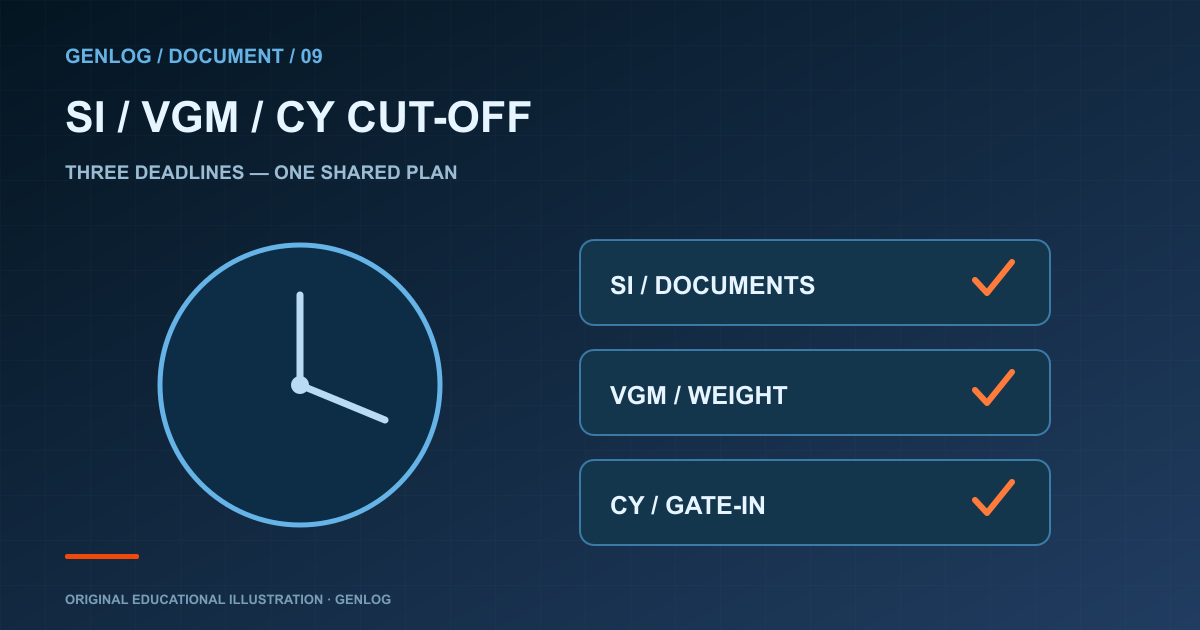
SI relates to document instructions, VGM to verified mass, and CY cut-off generally to container-yard acceptance. Obtain exact deadlines from the current booking and carrier/terminal instructions; there is no universal fixed-hour rule.
Share one schedule with separate milestones
GENLOG suggests recording each deadline, time zone, owner and confirmation status. ETD is an estimated departure, not the final time for every task. Allow time for corrections and out-of-hours document handling.
One shipment has several deadlines
A cut-off applies to a particular task or submission. ETD is an estimated departure, not a common deadline for everything. Keep the latest schedule with its receipt date and confirmer rather than an undated weekday in a chat.
Milestone
Required completion
Retained evidence
SI
Accepted document instructions
Acknowledgement and version
VGM
Accepted mass for the correct container
Submission status or reference
CY
Container received under terminal requirements
Interchange or gate-in record
Customs where applicable
Required declaration or clearance steps
Relevant processing status
ETD
Estimated departure
Updated schedule and later actual status
Plan backwards from each deadline
Obtain date, time, time zone and location for every milestone. Clarify ambiguous formats or missing details.
Assign individual owners for documents, VGM, packing, trucking and customs coordination.
Work backwards through preparation, travel and queuing, considering warehouse hours, route constraints and holidays.
Set internal targets earlier than external deadlines. A buffer is not a promise that last-minute delivery always works.
Track acceptance rather than merely sending data or dispatching a truck. Escalate unfinished dependencies early.
Distribute all schedule changes. Request written extensions specifying scope; extending SI does not automatically extend CY.
An illustrative schedule and delay response
Assume SI is due Monday 12:00, VGM Tuesday 10:00, CY Tuesday 16:00 and ETD Wednesday, all in the confirmed time zone. Complete document approval before SI, arrange weighing early enough for accepted VGM and allow trucking contingency before CY. Waiting until CY to address already-expired SI is not a workable sequence.
If the truck breaks down Tuesday morning, inform the provider, warehouse and receiver promptly. Check replacement transport or an accepted extension and evaluate a later sailing and associated charges. Keep the decision in writing. Gate-in does not prove loading on the vessel; verify the subsequent operational status and advise the buyer of changes.
Common questions
Do all cut-offs move when ETD moves? Obtain confirmation for each milestone.
What if a timely submission fails? Preserve the error, contact the designated support channel and obtain acceptance rather than relying on a sent email.
Is one day always enough contingency? Base the buffer on actual operations and schedules.
Is a telephone extension enough? Request booking-linked written confirmation with new time, zone and conditions.
When the schedule changes
Recheck all cut-offs, not just ETD. Obtain written confirmation of extensions; requesting one is not approval. Share the current schedule version with factory, trucking and documentation teams.
References
GENLOG practical guide, reviewed on 24 October 2026 using public primary sources. Examples are illustrations, not official tariffs or contract templates.
{"lang":"en","ui":{"home":"Home","services":"Services","lookup":"Lookup","tools":"Tools","knowledge":"Insights","contact":"Contact","quote":"Get a quote","explore":"Explore the platform","search":"Search","ports":"Ports \/ locations","carriers":"Shipping lines","container":"Container","searchPlaceholder":"Search port, location or shipping line…","trackingNote":"Track shipments on the shipping line’s official website.","map":"Logistics map","mapNote":"Geographic reference map; does not provide live vessel or shipment positions.","expand":"Expand map","cbm":"CBM calculator","cbmDesc":"Calculate shipment volume from package dimensions and quantity.","units":"Unit converter","unitsDesc":"Convert length, mass and volume.","containerDesc":"Validate ISO 6346 format and check digit.","carriersDesc":"Find shipping line websites and information from verified sources.","name":"Full name","company":"Company","email":"Email","phone":"Phone","service":"Service","origin":"Origin","destination":"Destination","cargo":"Cargo description","weight":"Total weight (kg)","volume":"Total volume (m³)","date":"Expected shipping date","notes":"Notes","consent":"I agree that GENLOG may use this information to respond under its","privacy":"Privacy policy","submit":"Send enquiry","formNote":"Fields marked * are required. Do not submit passwords or payment details.","sea":"Ocean freight","air":"Air freight","road":"Domestic transport","warehouse":"Warehousing","customs":"Customs clearance","transit":"Laos \/ Cambodia transit","other":"Other service","quoteReceived":"Your enquiry has been saved and accepted by the email system. GENLOG will contact you.","quoteSaved":"Your enquiry was saved. Email delivery is temporarily unavailable; contact alex@genlog.vn.","formError":"Some information is invalid. Please review the form.","requiredError":"Please complete all required fields.","rateError":"Too many enquiries. Please try again later.","notFound":"Page not found","backHome":"Return to home","close":"Close","length":"Length (cm)","width":"Width (cm)","height":"Height (cm)","quantity":"Packages","calculate":"Calculate","result":"Result","validContainer":"The container check digit is valid.","invalidContainer":"The check digit does not match.","formatContainer":"Enter 3 owner letters, U\/J\/Z, and 7 digits.","checkNote":"This checks only the format and check digit. It does not confirm existence or live location.","noResults":"No matching results yet. Contact GENLOG for assistance.","loading":"Searching…","networkError":"Connection unavailable. Please try again.","unitFrom":"From unit","unitTo":"To unit","value":"Value","directoryNote":"Directory entries are maintained from official sources. No live tracking data is provided.","readMore":"Read more","sources":"Data sources","terms":"Terms","footerTitle":"Connect with GENLOG","menu":"Open menu","cbmNote":"CBM is geometric volume. Chargeable weight and freight rates depend on the service and carrier.","platform":"LOGISTICS PLATFORM","countryFilter":"Country \/ territory","allCountries":"All countries","showMore":"Load more results","resultsCount":"{total} results found","catalogNote":"UN\/LOCODE {version} · {ports} port-function locations · {countries} countries\/territories.","menuClose":"Close menu","intro_services":"Transport solutions for each shipment, connecting Vietnam with international markets.","intro_lookup":"Find ports worldwide by name, UN\/LOCODE or country, with clear data sources.","intro_tools":"Calculate CBM, convert units and validate container numbers in one clear workspace.","intro_knowledge":"Practical information to help businesses prepare shipments and understand logistics.","intro_contact":"Share your shipment details. GENLOG will advise on a suitable solution and quotation.","intro_privacy":"How GENLOG receives and protects the information you provide.","intro_terms":"Guidelines for using the GENLOG platform, tools and logistics information.","intro_sources":"Data sources, versions and reference scope for the platform’s tools.","officialWebsite":"Official website ↗","cityFilter":"Head-office city","allCities":"All cities","carrierCountryFilter":"Head-office country \/ territory","carrierLocationNote":"Includes container, regional and other maritime freight operators. Filters use head-office locations, not route coverage or all local offices.","carrierSearchPlaceholder":"Carrier name, code or city…","documentMenu":"Open Document groups","selectSearch":"Type to find an option…","selectEmpty":"No matching options","selectOpen":"Open options","documentOverview":"Document overview","guideContents":"In this guide","quoteQueued":"Your enquiry has been saved. The email notification is queued, but mailbox delivery is not yet confirmed.","carrierCatalogNote":"Directory of {carriers} operators across {countries} countries\/territories."},"csrf":"846b02fb8152fe39483538a4f085778d00df83718f7fd88ce7395f7d3ad68bd3"}