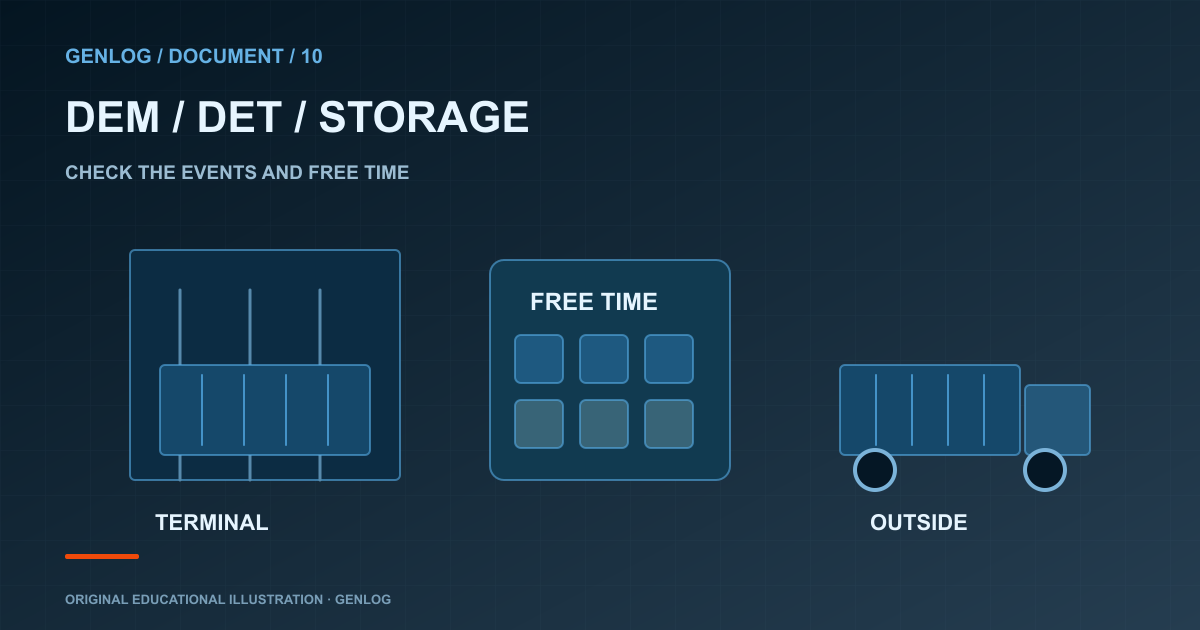
Common usage associates demurrage with terminal container time, detention with equipment outside, and storage with port/depot space. Carriers and markets may use separate or combined arrangements, so actual tariff definitions govern.
Free time needs a start and an end
GENLOG recommends recording the triggering events, calendar or working-day basis and equipment type, not just “five free days”. Carrier free time should not be assumed to waive every terminal storage charge.
Separate each charge and its clock
A DEM, DET or storage label is not enough to calculate an invoice. Obtain the tariff for provider, location, equipment, import/export movement and applicable period. Combined D&D arrangements also exist; one formula cannot serve every shipment.
Charge
General orientation
Verify
Demurrage
Usually container time inside a terminal
Start/end events and free time
Detention
Usually equipment time outside a terminal
Collection, empty return and counting
Storage
Facility storage
Charging party, scope and overlap
Combined D&D
A combined time arrangement
Shared clock and exceptions
Audit an invoice in six steps
Obtain the booking, confirmed free-time agreement and applicable tariff. Distinguish an indicative quote from shipment-specific confirmation.
Collect actual events required by that tariff, such as discharge, availability, collection and empty return.
Establish calendar or working days, first/last-day inclusion and holidays. Do not automatically exclude Sundays.
Build a daily ledger, mark free days and allocate paid days to tariff tiers. Check equipment count, currency, tax and separate facility items.
Reconcile each invoice line with events and evidence. Preserve rejected empty-return appointments and missing records for review.
Request clarification or dispute through the designated channel within its deadline. A dispute does not automatically suspend every charge.
An explicitly hypothetical tariff
Assume one agreed clock allows six free days with first and last-day treatment already defined. Event reconciliation leaves five chargeable days. A hypothetical tariff charges 50 USD for each of the first two paid days and 75 USD for each of the next three: 2 × 50 + 3 × 75 = 325 USD for one container before other charges or tax.
This does not imply that a particular carrier always grants six days or starts counting at discharge. For multiple containers, reconcile each event history before multiplying. Facility storage may have a distinct scope; check whether it runs concurrently, is included or requires an overlap explanation.
Common questions
Does free time waive all port charges? Identify which clock the allowance covers.
Are closed-depot weekends automatically free? Check applicable terms and obtain a decision supported by evidence.
What if no empty-return location accepts the box? Request written instructions, retain appointment/rejection evidence and notify the provider promptly.
How can exposure be reduced? Track each container’s last free day, plan clearance and trucks early, and confirm depot hours before dispatch.
Keep the event evidence
Retain free-time confirmation, applicable tariff, discharge, gate-out and empty-return records. Reconcile events as well as rates. For disputes, follow the billing party’s process with evidence rather than requesting an estimated day deduction.
References
GENLOG practical guide, reviewed on 24 October 2026 using public primary sources. Examples are illustrations, not official tariffs or contract templates.
{"lang":"en","ui":{"home":"Home","services":"Services","lookup":"Lookup","tools":"Tools","knowledge":"Insights","contact":"Contact","quote":"Get a quote","explore":"Explore the platform","search":"Search","ports":"Ports \/ locations","carriers":"Shipping lines","container":"Container","searchPlaceholder":"Search port, location or shipping line…","trackingNote":"Track shipments on the shipping line’s official website.","map":"Logistics map","mapNote":"Geographic reference map; does not provide live vessel or shipment positions.","expand":"Expand map","cbm":"CBM calculator","cbmDesc":"Calculate shipment volume from package dimensions and quantity.","units":"Unit converter","unitsDesc":"Convert length, mass and volume.","containerDesc":"Validate ISO 6346 format and check digit.","carriersDesc":"Find shipping line websites and information from verified sources.","name":"Full name","company":"Company","email":"Email","phone":"Phone","service":"Service","origin":"Origin","destination":"Destination","cargo":"Cargo description","weight":"Total weight (kg)","volume":"Total volume (m³)","date":"Expected shipping date","notes":"Notes","consent":"I agree that GENLOG may use this information to respond under its","privacy":"Privacy policy","submit":"Send enquiry","formNote":"Fields marked * are required. Do not submit passwords or payment details.","sea":"Ocean freight","air":"Air freight","road":"Domestic transport","warehouse":"Warehousing","customs":"Customs clearance","transit":"Laos \/ Cambodia transit","other":"Other service","quoteReceived":"Your enquiry has been saved and accepted by the email system. GENLOG will contact you.","quoteSaved":"Your enquiry was saved. Email delivery is temporarily unavailable; contact alex@genlog.vn.","formError":"Some information is invalid. Please review the form.","requiredError":"Please complete all required fields.","rateError":"Too many enquiries. Please try again later.","notFound":"Page not found","backHome":"Return to home","close":"Close","length":"Length (cm)","width":"Width (cm)","height":"Height (cm)","quantity":"Packages","calculate":"Calculate","result":"Result","validContainer":"The container check digit is valid.","invalidContainer":"The check digit does not match.","formatContainer":"Enter 3 owner letters, U\/J\/Z, and 7 digits.","checkNote":"This checks only the format and check digit. It does not confirm existence or live location.","noResults":"No matching results yet. Contact GENLOG for assistance.","loading":"Searching…","networkError":"Connection unavailable. Please try again.","unitFrom":"From unit","unitTo":"To unit","value":"Value","directoryNote":"Directory entries are maintained from official sources. No live tracking data is provided.","readMore":"Read more","sources":"Data sources","terms":"Terms","footerTitle":"Connect with GENLOG","menu":"Open menu","cbmNote":"CBM is geometric volume. Chargeable weight and freight rates depend on the service and carrier.","platform":"LOGISTICS PLATFORM","countryFilter":"Country \/ territory","allCountries":"All countries","showMore":"Load more results","resultsCount":"{total} results found","catalogNote":"UN\/LOCODE {version} · {ports} port-function locations · {countries} countries\/territories.","menuClose":"Close menu","intro_services":"Transport solutions for each shipment, connecting Vietnam with international markets.","intro_lookup":"Find ports worldwide by name, UN\/LOCODE or country, with clear data sources.","intro_tools":"Calculate CBM, convert units and validate container numbers in one clear workspace.","intro_knowledge":"Practical information to help businesses prepare shipments and understand logistics.","intro_contact":"Share your shipment details. GENLOG will advise on a suitable solution and quotation.","intro_privacy":"How GENLOG receives and protects the information you provide.","intro_terms":"Guidelines for using the GENLOG platform, tools and logistics information.","intro_sources":"Data sources, versions and reference scope for the platform’s tools.","officialWebsite":"Official website ↗","cityFilter":"Head-office city","allCities":"All cities","carrierCountryFilter":"Head-office country \/ territory","carrierLocationNote":"Includes container, regional and other maritime freight operators. Filters use head-office locations, not route coverage or all local offices.","carrierSearchPlaceholder":"Carrier name, code or city…","documentMenu":"Open Document groups","selectSearch":"Type to find an option…","selectEmpty":"No matching options","selectOpen":"Open options","documentOverview":"Document overview","guideContents":"In this guide","quoteQueued":"Your enquiry has been saved. The email notification is queued, but mailbox delivery is not yet confirmed.","carrierCatalogNote":"Directory of {carriers} operators across {countries} countries\/territories."},"csrf":"846b02fb8152fe39483538a4f085778d00df83718f7fd88ce7395f7d3ad68bd3"}