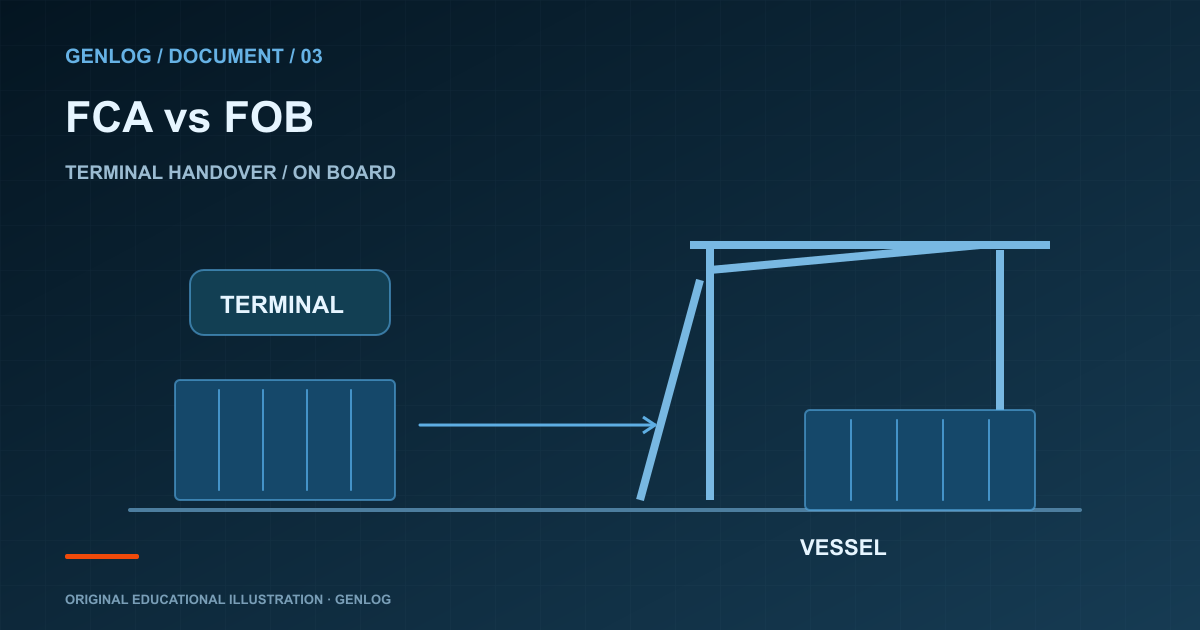
ICC’s checklist points to FCA for containers, multimodal movements and terminal delivery, while FOB places delivery on board the vessel. The seller’s actual handover arrangement therefore matters.
Draw the movement before choosing the term
GENLOG suggests marking factory, warehouse, terminal and vessel on a timeline. Record who receives goods from the seller and what evidence proves delivery. This can expose differences between contract wording and operating practice.
Compare actual delivery events
Container handover often happens before loading on the vessel. The commercial wording must match a provable event, so examine the interval rather than assuming the events coincide.
Question
FCA
FOB
Modes
One or more modes
Sea/inland waterway
Delivery to establish
Carrier/designated receiver at the agreed place
Goods on board at origin
Named location
Precise address and point
Loading port and relevant point
Evidence to check
Appropriate handover/receipt evidence
Appropriate on-board evidence
Frequent mistake
Vague place or unclear loading/unloading task
Treating warehouse receipt or gate-in as on-board delivery
Six checks for a container shipment
List truck arrival, loading, warehouse departure, terminal receipt and vessel loading. Identify control at each event.
Ask where the seller intends to complete delivery. FCA at the seller's premises and FCA elsewhere do not have identical loading/unloading arrangements; check the relevant application.
Inspect the records actually available. Truck receipts, gate records and B/L data may evidence different events.
Confirm who nominates the carrier, sends truck details and approves the collection plan. Agree how substitutions are communicated.
Check payment-document requirements with the bank and carrier if an on-board bill is required. Changing the acronym is not a document-management solution by itself.
Agree origin customs work, handover costs and evidence retention, and pass the approved scope to warehouse and trucking teams.
Scenario: gate-in before a delayed sailing
Assume terminal receipt on day 10, planned loading on day 12 and revised loading on day 15. Separate the receipt event from vessel loading and read the actual agreed delivery term. Gate-in alone does not answer the risk question.
For FCA at a precise point, establish whether the agreed delivery occurred and what proves it. For FOB, identify the relevant on-board delivery event. This exercise identifies evidence to collect; it does not decide a dispute.
Meanwhile, establish who can request a sailing change, contact the terminal and amend documents. Allocating a particular extra charge may require the sale agreement and actual service terms, not merely a yard receipt.
FAQ and avoidable errors
Is FCA limited to a factory? No; identify the agreed place and its applicable delivery arrangements.
Is familiar FOB wording enough? Repeated usage does not resolve a mismatch between contract and operations.
Can any truck receipt prove delivery? Check its signatory, time and recorded event against what must be established.
Avoid conflicting locations across contract, booking, quote and collection emails. Use a common location reference and an approved version.
Selection checklist
Specify the address or terminal, receiving party and delivery evidence. Confirm loading and unloading responsibilities at that point and export arrangements. If payment requires an on-board bill, discuss document availability separately with the bank and carrier.
References
GENLOG practical guide, reviewed on 24 October 2026 using public primary sources. Examples are illustrations, not official tariffs or contract templates.
{"lang":"en","ui":{"home":"Home","services":"Services","lookup":"Lookup","tools":"Tools","knowledge":"Insights","contact":"Contact","quote":"Get a quote","explore":"Explore the platform","search":"Search","ports":"Ports \/ locations","carriers":"Shipping lines","container":"Container","searchPlaceholder":"Search port, location or shipping line…","trackingNote":"Track shipments on the shipping line’s official website.","map":"Logistics map","mapNote":"Geographic reference map; does not provide live vessel or shipment positions.","expand":"Expand map","cbm":"CBM calculator","cbmDesc":"Calculate shipment volume from package dimensions and quantity.","units":"Unit converter","unitsDesc":"Convert length, mass and volume.","containerDesc":"Validate ISO 6346 format and check digit.","carriersDesc":"Find shipping line websites and information from verified sources.","name":"Full name","company":"Company","email":"Email","phone":"Phone","service":"Service","origin":"Origin","destination":"Destination","cargo":"Cargo description","weight":"Total weight (kg)","volume":"Total volume (m³)","date":"Expected shipping date","notes":"Notes","consent":"I agree that GENLOG may use this information to respond under its","privacy":"Privacy policy","submit":"Send enquiry","formNote":"Fields marked * are required. Do not submit passwords or payment details.","sea":"Ocean freight","air":"Air freight","road":"Domestic transport","warehouse":"Warehousing","customs":"Customs clearance","transit":"Laos \/ Cambodia transit","other":"Other service","quoteReceived":"Your enquiry has been saved and accepted by the email system. GENLOG will contact you.","quoteSaved":"Your enquiry was saved. Email delivery is temporarily unavailable; contact alex@genlog.vn.","formError":"Some information is invalid. Please review the form.","requiredError":"Please complete all required fields.","rateError":"Too many enquiries. Please try again later.","notFound":"Page not found","backHome":"Return to home","close":"Close","length":"Length (cm)","width":"Width (cm)","height":"Height (cm)","quantity":"Packages","calculate":"Calculate","result":"Result","validContainer":"The container check digit is valid.","invalidContainer":"The check digit does not match.","formatContainer":"Enter 3 owner letters, U\/J\/Z, and 7 digits.","checkNote":"This checks only the format and check digit. It does not confirm existence or live location.","noResults":"No matching results yet. Contact GENLOG for assistance.","loading":"Searching…","networkError":"Connection unavailable. Please try again.","unitFrom":"From unit","unitTo":"To unit","value":"Value","directoryNote":"Directory entries are maintained from official sources. No live tracking data is provided.","readMore":"Read more","sources":"Data sources","terms":"Terms","footerTitle":"Connect with GENLOG","menu":"Open menu","cbmNote":"CBM is geometric volume. Chargeable weight and freight rates depend on the service and carrier.","platform":"LOGISTICS PLATFORM","countryFilter":"Country \/ territory","allCountries":"All countries","showMore":"Load more results","resultsCount":"{total} results found","catalogNote":"UN\/LOCODE {version} · {ports} port-function locations · {countries} countries\/territories.","menuClose":"Close menu","intro_services":"Transport solutions for each shipment, connecting Vietnam with international markets.","intro_lookup":"Find ports worldwide by name, UN\/LOCODE or country, with clear data sources.","intro_tools":"Calculate CBM, convert units and validate container numbers in one clear workspace.","intro_knowledge":"Practical information to help businesses prepare shipments and understand logistics.","intro_contact":"Share your shipment details. GENLOG will advise on a suitable solution and quotation.","intro_privacy":"How GENLOG receives and protects the information you provide.","intro_terms":"Guidelines for using the GENLOG platform, tools and logistics information.","intro_sources":"Data sources, versions and reference scope for the platform’s tools.","officialWebsite":"Official website ↗","cityFilter":"Head-office city","allCities":"All cities","carrierCountryFilter":"Head-office country \/ territory","carrierLocationNote":"Includes container, regional and other maritime freight operators. Filters use head-office locations, not route coverage or all local offices.","carrierSearchPlaceholder":"Carrier name, code or city…","documentMenu":"Open Document groups","selectSearch":"Type to find an option…","selectEmpty":"No matching options","selectOpen":"Open options","documentOverview":"Document overview","guideContents":"In this guide","quoteQueued":"Your enquiry has been saved. The email notification is queued, but mailbox delivery is not yet confirmed.","carrierCatalogNote":"Directory of {carriers} operators across {countries} countries\/territories."},"csrf":"846b02fb8152fe39483538a4f085778d00df83718f7fd88ce7395f7d3ad68bd3"}