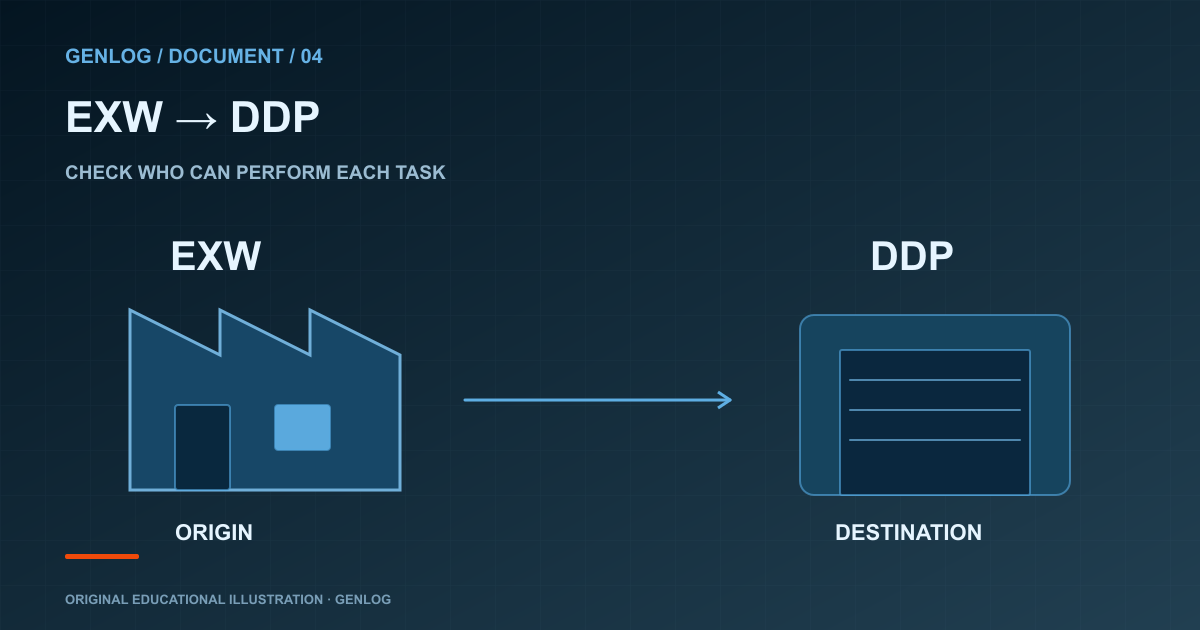
EXW normally makes goods available at the named place without loading the collecting vehicle. DDP gives the seller broader destination and import obligations, with unloading generally for the buyer. Local rules can affect whether these arrangements are workable.
Convenience does not establish legal capability
Under EXW, check who can carry out export formalities. Under DDP, verify how the seller can perform the import obligations in the destination country. Choosing an acronym does not itself give a party the legal capacity to clear goods.
Assess feasibility, not a convenient label
Describing EXW as “least work” and DDP as “everything delivered” can conceal practical gaps. Check delivery, loading/unloading and customs capability before accepting either.
Issue
EXW
DDP
Basic delivery
Named origin place, available to buyer
Named destination, ready for unloading under the rule
Handling
Do not assume seller loading on collection
Do not assume seller unloading at destination
Export
Check buyer/designated party capability
Establish seller arrangements
Import/taxes
Identify responsibility and quotation scope
Verify seller can perform DDP import obligations locally
Critical obstacle
Buyer cannot implement export plan
Seller cannot implement destination import plan
Before quoting: six checks
Identify goods, origin, markets and actual parties. A destination address is not a feasibility assessment.
Verify who can perform and be named in local customs procedures. Ask qualified support about the operating model, not simply whether “DDP service” exists.
Separate seller, buyer, agent and carrier tasks. Appointing an agent does not itself remove agreed responsibilities between buyer and seller.
List unresolved taxes, inspections, permits, corrections, failed delivery and waiting. Record the basis for each and who approves changes.
Confirm handling, receiving windows, lifting equipment and access. A customs solution alone may not make final delivery executable.
If the scope is unworkable, agree an appropriate alternative before booking. Do not retain a DDP label while verbally excluding a core obligation.
Scenario: what is missing from “DDP warehouse B”?
A seller wants an inclusive warehouse price but has not confirmed who can implement import procedures. Resolve parties, product information, records and the locally acceptable model first. A port-to-warehouse trucking quote does not establish customs eligibility.
Once a workable model is confirmed, agree the treatment of unresolved amounts and requests for additional records. This is transaction clarification, not automatic permission to transfer every extra cost to the buyer. If the model cannot meet DDP, discuss another appropriate arrangement.
For EXW, reverse the exercise: has the buyer arranged export and collection, and what happens if the truck arrives without suitable handling instructions? Settle scope and an approved plan rather than relying on assumptions.
Questions and frequent mistakes
Does DDP guarantee destination acceptance? No; product and local implementation requirements still matter.
Is appointing a customs agent enough? Understand authorization, documents and the actual division of responsibilities.
Is EXW always cheapest? A low goods price can leave substantial buyer-arranged tasks. Compare the same final delivery scope.
Avoid “everything included” while leaving taxes, inspections or unloading undefined. Identify confirmed items, conditional items and the approval process for changes.
Feasibility checklist
Specify the place, loading or unloading task, customs parties and expected taxes. Check both jurisdictions with qualified support. Record agent responsibilities and document handovers. This learning guide is not transaction-specific contract wording.
References
GENLOG practical guide, reviewed on 24 October 2026 using public primary sources. Examples are illustrations, not official tariffs or contract templates.
{"lang":"en","ui":{"home":"Home","services":"Services","lookup":"Lookup","tools":"Tools","knowledge":"Insights","contact":"Contact","quote":"Get a quote","explore":"Explore the platform","search":"Search","ports":"Ports \/ locations","carriers":"Shipping lines","container":"Container","searchPlaceholder":"Search port, location or shipping line…","trackingNote":"Track shipments on the shipping line’s official website.","map":"Logistics map","mapNote":"Geographic reference map; does not provide live vessel or shipment positions.","expand":"Expand map","cbm":"CBM calculator","cbmDesc":"Calculate shipment volume from package dimensions and quantity.","units":"Unit converter","unitsDesc":"Convert length, mass and volume.","containerDesc":"Validate ISO 6346 format and check digit.","carriersDesc":"Find shipping line websites and information from verified sources.","name":"Full name","company":"Company","email":"Email","phone":"Phone","service":"Service","origin":"Origin","destination":"Destination","cargo":"Cargo description","weight":"Total weight (kg)","volume":"Total volume (m³)","date":"Expected shipping date","notes":"Notes","consent":"I agree that GENLOG may use this information to respond under its","privacy":"Privacy policy","submit":"Send enquiry","formNote":"Fields marked * are required. Do not submit passwords or payment details.","sea":"Ocean freight","air":"Air freight","road":"Domestic transport","warehouse":"Warehousing","customs":"Customs clearance","transit":"Laos \/ Cambodia transit","other":"Other service","quoteReceived":"Your enquiry has been saved and accepted by the email system. GENLOG will contact you.","quoteSaved":"Your enquiry was saved. Email delivery is temporarily unavailable; contact alex@genlog.vn.","formError":"Some information is invalid. Please review the form.","requiredError":"Please complete all required fields.","rateError":"Too many enquiries. Please try again later.","notFound":"Page not found","backHome":"Return to home","close":"Close","length":"Length (cm)","width":"Width (cm)","height":"Height (cm)","quantity":"Packages","calculate":"Calculate","result":"Result","validContainer":"The container check digit is valid.","invalidContainer":"The check digit does not match.","formatContainer":"Enter 3 owner letters, U\/J\/Z, and 7 digits.","checkNote":"This checks only the format and check digit. It does not confirm existence or live location.","noResults":"No matching results yet. Contact GENLOG for assistance.","loading":"Searching…","networkError":"Connection unavailable. Please try again.","unitFrom":"From unit","unitTo":"To unit","value":"Value","directoryNote":"Directory entries are maintained from official sources. No live tracking data is provided.","readMore":"Read more","sources":"Data sources","terms":"Terms","footerTitle":"Connect with GENLOG","menu":"Open menu","cbmNote":"CBM is geometric volume. Chargeable weight and freight rates depend on the service and carrier.","platform":"LOGISTICS PLATFORM","countryFilter":"Country \/ territory","allCountries":"All countries","showMore":"Load more results","resultsCount":"{total} results found","catalogNote":"UN\/LOCODE {version} · {ports} port-function locations · {countries} countries\/territories.","menuClose":"Close menu","intro_services":"Transport solutions for each shipment, connecting Vietnam with international markets.","intro_lookup":"Find ports worldwide by name, UN\/LOCODE or country, with clear data sources.","intro_tools":"Calculate CBM, convert units and validate container numbers in one clear workspace.","intro_knowledge":"Practical information to help businesses prepare shipments and understand logistics.","intro_contact":"Share your shipment details. GENLOG will advise on a suitable solution and quotation.","intro_privacy":"How GENLOG receives and protects the information you provide.","intro_terms":"Guidelines for using the GENLOG platform, tools and logistics information.","intro_sources":"Data sources, versions and reference scope for the platform’s tools.","officialWebsite":"Official website ↗","cityFilter":"Head-office city","allCities":"All cities","carrierCountryFilter":"Head-office country \/ territory","carrierLocationNote":"Includes container, regional and other maritime freight operators. Filters use head-office locations, not route coverage or all local offices.","carrierSearchPlaceholder":"Carrier name, code or city…","documentMenu":"Open Document groups","selectSearch":"Type to find an option…","selectEmpty":"No matching options","selectOpen":"Open options","documentOverview":"Document overview","guideContents":"In this guide","quoteQueued":"Your enquiry has been saved. The email notification is queued, but mailbox delivery is not yet confirmed.","carrierCatalogNote":"Directory of {carriers} operators across {countries} countries\/territories."},"csrf":"846b02fb8152fe39483538a4f085778d00df83718f7fd88ce7395f7d3ad68bd3"}