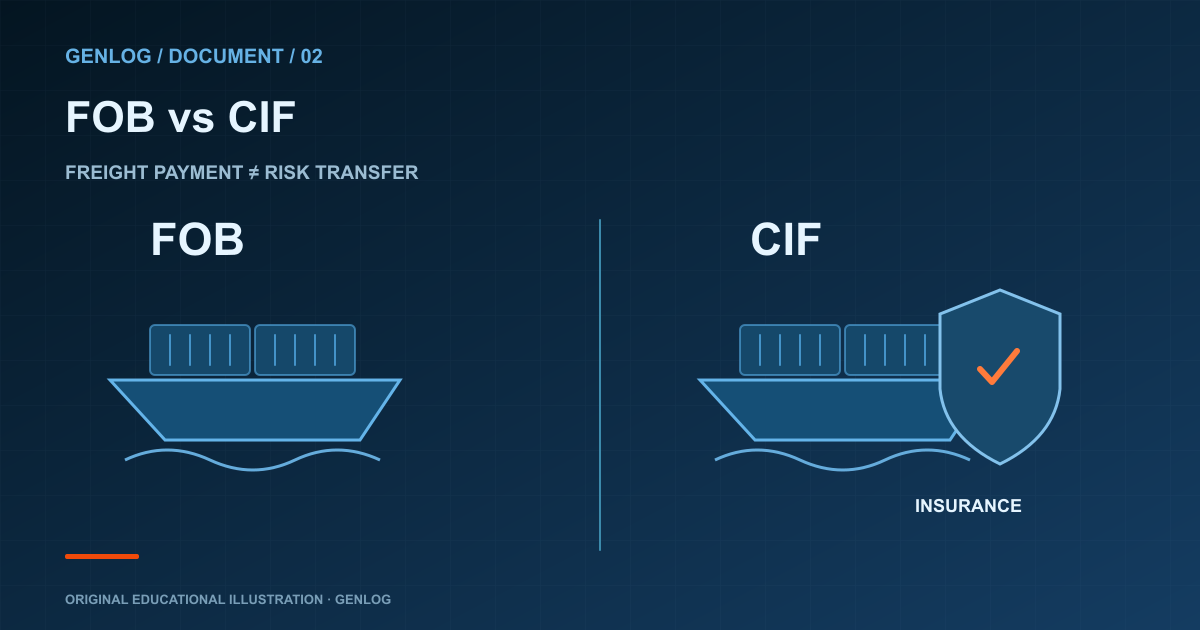
FOB and CIF are maritime and inland-waterway rules. Under Incoterms® 2020, delivery and risk transfer under both occur when goods are on board at origin. CIF also requires the seller to arrange carriage and the required insurance.
Freight payment is not continuing risk
Naming a destination under CIF does not make the seller responsible for every risk until arrival. Separate the goods price, carriage and insurance scope. CIF insurance is not automatically cover for every loss; review its terms and exclusions.
Compare FOB and CIF on the same basis
Ask the same question of each offer. This table is an orientation, to be read with the selected rules and sales agreement.
Issue
FOB
CIF
Transport group
Sea/inland waterway
Sea/inland waterway
Basic delivery event
On board at origin
On board at origin
Main sea carriage
Normally arranged by buyer
Arranged by seller under the rule
Seller insurance obligation
Not the CIF insurance obligation
Insurance must be arranged as required by CIF
Destination check
Identify unquoted costs and responsibilities
Establish what the price includes and excludes
A six-step offer review
Establish whether the term belongs to the sales contract or is shorthand in a transport quotation. They are not automatically the same commitment.
Identify both ports. The destination in CIF does not remove the need to understand origin delivery and on-board evidence.
Confirm who books, changes sailings and instructs the carrier. Use one coordinator when multiple parties communicate directly.
Itemize origin, main freight, insurance, destination and inland charges. Mark included, excluded and unknown items explicitly.
For CIF, review insured parties, voyage, cover, exclusions and loss-notification requirements. Do not infer a particular claim outcome from the acronym.
Agree document provision and escalation arrangements, then retain confirmations with the contract.
Worked comparison to final delivery
Suppose offer A is FOB port A at USD 20,000 and offer B is CIF port B at USD 21,300. The buyer estimates USD 1,000 freight and USD 150 insurance for the FOB offer. Its intermediate total is USD 21,150, but that does not prove it is cheaper.
Check product specifications, transport scope, insurance quality and destination costs. A USD 300 item excluded by one offer and included by another changes the comparison. These are teaching figures, not GENLOG prices.
If damage occurs after loading, asking only who paid freight is inadequate. Collect event evidence, sale terms, transport documents and insurance details for the responsible claims team. An acronym alone cannot determine liability in an actual incident.
Questions and common errors
Does CIF insure every possible risk? Review the actual policy and required cover; supplementary arrangements may be necessary.
Can the buyer change a CIF carrier unilaterally? Discuss the request with the contracting parties rather than issuing conflicting instructions.
Is FOB comparable to a delivered-warehouse quote? Only after aligning scope and conditions. Consider FCA or another appropriate rule when the real handover is at a terminal.
Avoid writing CIF without confirming insurance evidence, or treating FOB operationally as risk continuing to destination. Convert assumptions into written agreement.
Questions to settle
Who books and changes the sailing? What ports and dates are specified? Who supplies insurance documents and handles loss notifications? For containers handed over at a terminal, also assess FCA rather than choosing a familiar maritime acronym automatically.
References
GENLOG practical guide, reviewed on 24 October 2026 using public primary sources. Examples are illustrations, not official tariffs or contract templates.
{"lang":"en","ui":{"home":"Home","services":"Services","lookup":"Lookup","tools":"Tools","knowledge":"Insights","contact":"Contact","quote":"Get a quote","explore":"Explore the platform","search":"Search","ports":"Ports \/ locations","carriers":"Shipping lines","container":"Container","searchPlaceholder":"Search port, location or shipping line…","trackingNote":"Track shipments on the shipping line’s official website.","map":"Logistics map","mapNote":"Geographic reference map; does not provide live vessel or shipment positions.","expand":"Expand map","cbm":"CBM calculator","cbmDesc":"Calculate shipment volume from package dimensions and quantity.","units":"Unit converter","unitsDesc":"Convert length, mass and volume.","containerDesc":"Validate ISO 6346 format and check digit.","carriersDesc":"Find shipping line websites and information from verified sources.","name":"Full name","company":"Company","email":"Email","phone":"Phone","service":"Service","origin":"Origin","destination":"Destination","cargo":"Cargo description","weight":"Total weight (kg)","volume":"Total volume (m³)","date":"Expected shipping date","notes":"Notes","consent":"I agree that GENLOG may use this information to respond under its","privacy":"Privacy policy","submit":"Send enquiry","formNote":"Fields marked * are required. Do not submit passwords or payment details.","sea":"Ocean freight","air":"Air freight","road":"Domestic transport","warehouse":"Warehousing","customs":"Customs clearance","transit":"Laos \/ Cambodia transit","other":"Other service","quoteReceived":"Your enquiry has been saved and accepted by the email system. GENLOG will contact you.","quoteSaved":"Your enquiry was saved. Email delivery is temporarily unavailable; contact alex@genlog.vn.","formError":"Some information is invalid. Please review the form.","requiredError":"Please complete all required fields.","rateError":"Too many enquiries. Please try again later.","notFound":"Page not found","backHome":"Return to home","close":"Close","length":"Length (cm)","width":"Width (cm)","height":"Height (cm)","quantity":"Packages","calculate":"Calculate","result":"Result","validContainer":"The container check digit is valid.","invalidContainer":"The check digit does not match.","formatContainer":"Enter 3 owner letters, U\/J\/Z, and 7 digits.","checkNote":"This checks only the format and check digit. It does not confirm existence or live location.","noResults":"No matching results yet. Contact GENLOG for assistance.","loading":"Searching…","networkError":"Connection unavailable. Please try again.","unitFrom":"From unit","unitTo":"To unit","value":"Value","directoryNote":"Directory entries are maintained from official sources. No live tracking data is provided.","readMore":"Read more","sources":"Data sources","terms":"Terms","footerTitle":"Connect with GENLOG","menu":"Open menu","cbmNote":"CBM is geometric volume. Chargeable weight and freight rates depend on the service and carrier.","platform":"LOGISTICS PLATFORM","countryFilter":"Country \/ territory","allCountries":"All countries","showMore":"Load more results","resultsCount":"{total} results found","catalogNote":"UN\/LOCODE {version} · {ports} port-function locations · {countries} countries\/territories.","menuClose":"Close menu","intro_services":"Transport solutions for each shipment, connecting Vietnam with international markets.","intro_lookup":"Find ports worldwide by name, UN\/LOCODE or country, with clear data sources.","intro_tools":"Calculate CBM, convert units and validate container numbers in one clear workspace.","intro_knowledge":"Practical information to help businesses prepare shipments and understand logistics.","intro_contact":"Share your shipment details. GENLOG will advise on a suitable solution and quotation.","intro_privacy":"How GENLOG receives and protects the information you provide.","intro_terms":"Guidelines for using the GENLOG platform, tools and logistics information.","intro_sources":"Data sources, versions and reference scope for the platform’s tools.","officialWebsite":"Official website ↗","cityFilter":"Head-office city","allCities":"All cities","carrierCountryFilter":"Head-office country \/ territory","carrierLocationNote":"Includes container, regional and other maritime freight operators. Filters use head-office locations, not route coverage or all local offices.","carrierSearchPlaceholder":"Carrier name, code or city…","documentMenu":"Open Document groups","selectSearch":"Type to find an option…","selectEmpty":"No matching options","selectOpen":"Open options","documentOverview":"Document overview","guideContents":"In this guide","quoteQueued":"Your enquiry has been saved. The email notification is queued, but mailbox delivery is not yet confirmed.","carrierCatalogNote":"Directory of {carriers} operators across {countries} countries\/territories."},"csrf":"846b02fb8152fe39483538a4f085778d00df83718f7fd88ce7395f7d3ad68bd3"}