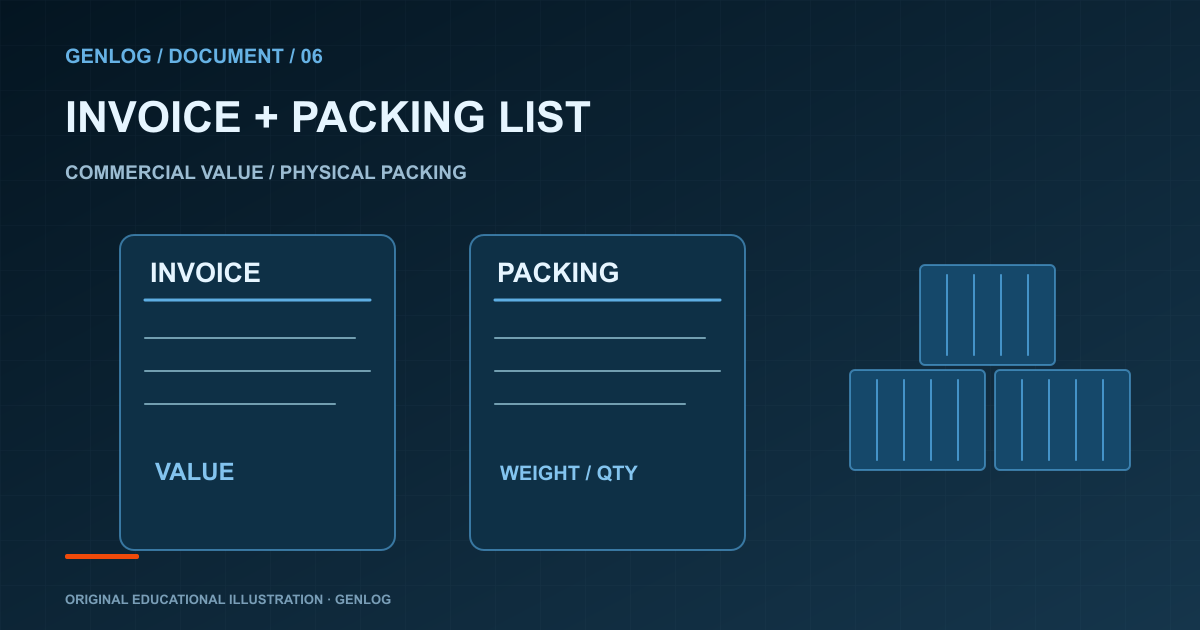
The commercial invoice records the goods transaction and value information. The packing list describes how cargo is arranged in packages, cartons or pallets. Neither should be used to guess all the information needed by the other.
Work from an approved common dataset
GENLOG suggests using agreed descriptions and quantities, then adding values to the invoice and packing detail to the packing list. Verify weights, package counts and units against the actual cargo. Confirm destination-specific requirements before issuing documents.
Two documents, different purposes
The invoice describes the transaction and value; the packing list identifies how goods are packed. Use a shared shipment reference and version control without copying every field mechanically. Destination and product requirements still need separate verification.
Information
Commercial invoice
Packing list
Parties
Seller, buyer and transaction addresses
Shipment and party references
Goods
Description, quantity, unit price, amount and currency
Package marks, contents and packing method
Weight
As required for the transaction and declaration
Clearly labelled net, gross and units
References
Number, date, PO and named delivery term
Related invoice, package total and dimensions
Preparation and cross-check workflow
Identify authoritative data: contract or PO for prices, warehouse for actual packed quantities and compliance staff for product requirements.
Calculate each invoice line and state currency and units. Keep agreed discounts and additional charges traceable.
Build the packing list from actual packing, with enough package detail for identification. Replace estimates once packing is complete.
Recalculate quantities, packages and weights; compare with SI, customs data and origin documents where applicable.
Confirm buyer and destination requirements for language, signatures, originals, permits and certificates. One template is not universally sufficient.
Approve and release a versioned final set, withdraw obsolete copies and update every affected document after a quantity change.
A quantity and weight reconciliation
An illustrative shipment has 100 cartons containing ten units each: 1,000 units in total. Goods net weight is 2,000 kg and package materials weigh 100 kg, giving cargo gross weight of 2,100 kg. Do not add container tare to this cargo figure; packed-container VGM is separate.
If the invoice states 900 units while the packing list states 1,000, check the physical shipment and PO first. Do not reduce the packing list merely to match the invoice. The discrepancy might reflect a short shipment, an obsolete version or additional goods needing appropriate description and valuation treatment. Record the cause and any declaration changes.
Common questions and mistakes
Can the packing list replace the invoice? No; packing detail does not replace transaction value information.
Must every invoice show an HS code? Required fields depend on its use. Verify with the declarant and do not select classification from a casual product name alone.
Is “parts” a sufficient description? Identify the actual product and applicable destination requirements; obtain specialist clarification when needed.
Independently check kg/lb, decimal notation, currency and arithmetic. Matching two copies from the same incorrect source is not a reliable check.
Reconciliation checklist
Check references, dates, seller and buyer, descriptions and units, package counts and net/gross weights. Reconcile delivery terms and receiver requirements. Confirm any HS or other market-specific data; a generic template is not a universally mandatory form.
References
GENLOG practical guide, reviewed on 24 October 2026 using public primary sources. Examples are illustrations, not official tariffs or contract templates.
{"lang":"en","ui":{"home":"Home","services":"Services","lookup":"Lookup","tools":"Tools","knowledge":"Insights","contact":"Contact","quote":"Get a quote","explore":"Explore the platform","search":"Search","ports":"Ports \/ locations","carriers":"Shipping lines","container":"Container","searchPlaceholder":"Search port, location or shipping line…","trackingNote":"Track shipments on the shipping line’s official website.","map":"Logistics map","mapNote":"Geographic reference map; does not provide live vessel or shipment positions.","expand":"Expand map","cbm":"CBM calculator","cbmDesc":"Calculate shipment volume from package dimensions and quantity.","units":"Unit converter","unitsDesc":"Convert length, mass and volume.","containerDesc":"Validate ISO 6346 format and check digit.","carriersDesc":"Find shipping line websites and information from verified sources.","name":"Full name","company":"Company","email":"Email","phone":"Phone","service":"Service","origin":"Origin","destination":"Destination","cargo":"Cargo description","weight":"Total weight (kg)","volume":"Total volume (m³)","date":"Expected shipping date","notes":"Notes","consent":"I agree that GENLOG may use this information to respond under its","privacy":"Privacy policy","submit":"Send enquiry","formNote":"Fields marked * are required. Do not submit passwords or payment details.","sea":"Ocean freight","air":"Air freight","road":"Domestic transport","warehouse":"Warehousing","customs":"Customs clearance","transit":"Laos \/ Cambodia transit","other":"Other service","quoteReceived":"Your enquiry has been saved and accepted by the email system. GENLOG will contact you.","quoteSaved":"Your enquiry was saved. Email delivery is temporarily unavailable; contact alex@genlog.vn.","formError":"Some information is invalid. Please review the form.","requiredError":"Please complete all required fields.","rateError":"Too many enquiries. Please try again later.","notFound":"Page not found","backHome":"Return to home","close":"Close","length":"Length (cm)","width":"Width (cm)","height":"Height (cm)","quantity":"Packages","calculate":"Calculate","result":"Result","validContainer":"The container check digit is valid.","invalidContainer":"The check digit does not match.","formatContainer":"Enter 3 owner letters, U\/J\/Z, and 7 digits.","checkNote":"This checks only the format and check digit. It does not confirm existence or live location.","noResults":"No matching results yet. Contact GENLOG for assistance.","loading":"Searching…","networkError":"Connection unavailable. Please try again.","unitFrom":"From unit","unitTo":"To unit","value":"Value","directoryNote":"Directory entries are maintained from official sources. No live tracking data is provided.","readMore":"Read more","sources":"Data sources","terms":"Terms","footerTitle":"Connect with GENLOG","menu":"Open menu","cbmNote":"CBM is geometric volume. Chargeable weight and freight rates depend on the service and carrier.","platform":"LOGISTICS PLATFORM","countryFilter":"Country \/ territory","allCountries":"All countries","showMore":"Load more results","resultsCount":"{total} results found","catalogNote":"UN\/LOCODE {version} · {ports} port-function locations · {countries} countries\/territories.","menuClose":"Close menu","intro_services":"Transport solutions for each shipment, connecting Vietnam with international markets.","intro_lookup":"Find ports worldwide by name, UN\/LOCODE or country, with clear data sources.","intro_tools":"Calculate CBM, convert units and validate container numbers in one clear workspace.","intro_knowledge":"Practical information to help businesses prepare shipments and understand logistics.","intro_contact":"Share your shipment details. GENLOG will advise on a suitable solution and quotation.","intro_privacy":"How GENLOG receives and protects the information you provide.","intro_terms":"Guidelines for using the GENLOG platform, tools and logistics information.","intro_sources":"Data sources, versions and reference scope for the platform’s tools.","officialWebsite":"Official website ↗","cityFilter":"Head-office city","allCities":"All cities","carrierCountryFilter":"Head-office country \/ territory","carrierLocationNote":"Includes container, regional and other maritime freight operators. Filters use head-office locations, not route coverage or all local offices.","carrierSearchPlaceholder":"Carrier name, code or city…","documentMenu":"Open Document groups","selectSearch":"Type to find an option…","selectEmpty":"No matching options","selectOpen":"Open options","documentOverview":"Document overview","guideContents":"In this guide","quoteQueued":"Your enquiry has been saved. The email notification is queued, but mailbox delivery is not yet confirmed.","carrierCatalogNote":"Directory of {carriers} operators across {countries} countries\/territories."},"csrf":"846b02fb8152fe39483538a4f085778d00df83718f7fd88ce7395f7d3ad68bd3"}